
The UK Beatbox Championships celebrated its 20th Anniversary in 2025 and is recognised for its professional-level competition that brings together talented musicians from across the UK and the globe.
As part of the 20-year celebration we held an international chess style clock battle to celebrate beatboxers from around the world and gave them to chance to battle on the UKBC stage. Due to the popularity and demand, we are bringing it back for 2026!
The competition again will consist of part invitation and part wildcard (online submission) entry.
Read all the relevant entry guidelines, record your wildcard and fill out the entry form for the Battle Clock Beatbox Champs International category below
IMPORTANT – If you do not fill out and submit a entry form this will mean your entry video will not be seen and subsequently not be a valid entry into the competition.
The Battle Clock Beatbox Championships (International Category) will work like this:
The competition will feature 4 invited competitors and a minimum of 4 Wildcard places. UKBC reserves the right to revise these numbers at its sole discretion.
17th October 2026 (Day 1)
18th October 2026 (Day 2)
The “Battle Clock” will works as follows:
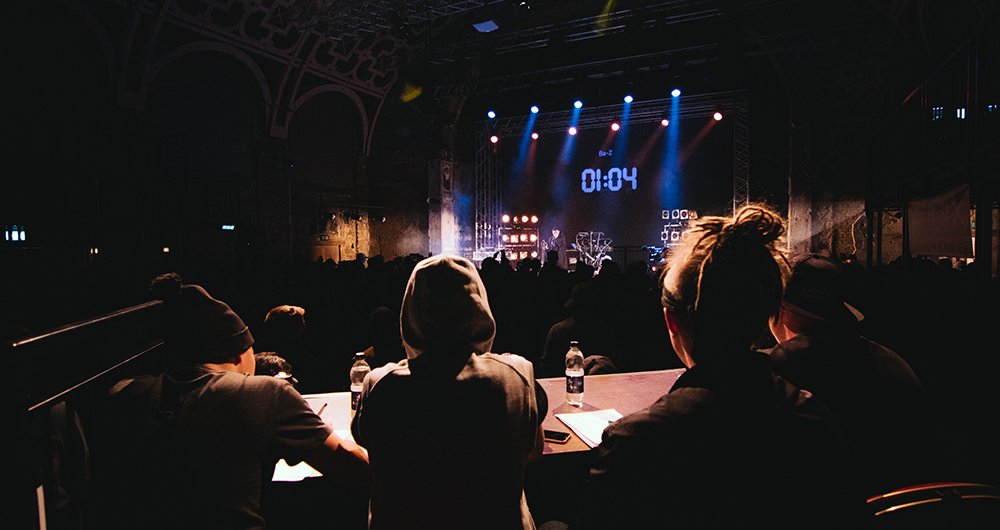
As seen very rarely in the beatbox battle scene, this battle format will be using a ‘chess clock’ or ‘buzzer’ to pass the round over to your opponent.
Each battle will consist of 1:30 minutes of battle time, per battler (3 minutes in total). The time can be used however the current battler chooses and they can “buzz” over their round by hitting the button on stage. For example, Beatboxer A could start and use 40 seconds of their round (leaving 5o seconds left) then “buzz” over to Beatboxer B who uses 1 minute of their round and so on until each beatboxer’s time is finished. Judges will then vote in the normal judging style.
RULES
There are only 2 rules for this category and these are:
Yes anyone from around the world is permitted to enter and submit an entry.
For 2026 we are also offering one place to a UK based competitor to show what they have battling against the international scene!
If you are chosen to enter the battle you will be responsible for your own entry into the UK and any visa requirements that may be needed for your visit. Important – make sure you will be able to get a visa in time. You can find more info here: https://www.gov.uk/check-uk-visa
We are of course here to help and can advise where possible with invitation/visa support letters that may help with the process. If you think you require one or are unsure, please contact us at admin@ukbeatboxchampionships.com so we can discuss with you further.
You/they must be 18+ years of age to enter the Battle Clock category
Submit a Solo Video Wildcard of up to 1:30 minutes (90 seconds) +/- 5% in length. Not sticking to the length may result in marking your entry down. Your spoken intro to your entry is not included in this time limit.
At the beginning of your Video Submission you must say, “My name is ________ and this is my submission to Battle Clock Beatbox Championships at UKBC 2026”. Upload your video to YouTube with the title “Your Name – 2026 UKBC – Battle Clock Beatbox Championships”.
Entry videos must be shot live and overdubbing is not allowed. You can use minimal audio fx such as eq, compression and reverb and no automation of any kind is allowed. For more in-depth info on audio processing please read the “Can I process the audio of my entry?” question.
Judges will rank all entries and the Top 4 ranked International Battlers will join the 4 invitees to enter the live Eliminations 20th September 2025. From this a Top 8 will be ranked to enter the battles on 20th & 21st September 2025.
Entries to UK Beatbox Championships may process audio mix after recording under the following rules:
Each participant must keep RAW audio files of their demo entry and have these ready to send (if they are requested by the judges).
Please keep these ready until AFTER DEMO SUBMISSION RESULTS ANNOUNCEMENT
D-Low 🇬🇧 || Heartzel 🇲🇾 || Zede 🇨🇭
Judging criteria will be based on but not limited to Originality, Musicality, Technicality, Flow/Performance and Stage Presence (live battles only).
For more information on judging criteria examples visit the battle info page here.
All competitors must agree to, complete and sign a Media Release Form prior to the event to be allowed to participate in the live event. Under 18 competitors must get their parent or legal guardian to sign on their behalf.
All competitors must agree to, complete and sign a Code of Conduct form prior to the event to be allowed to participate in the live event. Under 18 competitors must get their parent or legal guardian to sign on their behalf.
The Code of Conduct can be found here.
Showcase Eliminations – 1 x round of 3 minutes
Quarter Finals – 2 x rounds of 1:30 minutes
Semi Finals – 2 x rounds of 1:30 minutes
Finals – 2 x rounds of 1:30 minutes
All battles will be using the ‘chess clock’ or ‘buzzer’ system.
Each beatboxers gets 1:30 mins to use in their round and can buzz to their opponent when they like. The buzzer must be pressed a minimum of once per battler.
In the eliminations the shortlisting by the judges is based on whether they want to see you go through to the battle stage. The elimination is not a battle so you need to impress the judges that you have what it takes to compete.
The judges will be looking at your Musicality, Technicality, Originality and Performance. In the battles the judges will also be looking at your Engagement.
This is not an exhaustive list but some general guidelines:
Musicality refers to how effectively you use beatboxing as a form of music. Judges will assess the overall composition, arrangement and musical structure of your routine, including how ideas are introduced, developed and concluded. A strong performance should feel intentional, engaging and well-crafted from beginning to end.
Competitors should consider elements such as melody, harmony, bass lines, rhythm, dynamics and song structure. Judges will evaluate how these elements work together to create a cohesive and enjoyable musical experience. Routines that demonstrate effective build-ups, transitions, climaxes and endings are likely to score higher in this category.
Where melodic elements are used, competitors will be judged on pitch accuracy, tone, timbre and overall musical execution. Vocal melodies, bass lines and lead parts should be delivered with confidence and control, contributing positively to the overall composition.
If lyrics, spoken word or vocal samples are included, judges will also consider their clarity, audibility and how effectively they complement the performance. All musical elements should work together to create a routine that is both technically sound and musically engaging.
Technicality refers to the execution, complexity and control of a competitor’s beatboxing. While speed can be a factor, judges will place greater emphasis on the clarity, precision and consistency of the sounds being performed.
Judges will assess the range and diversity of sounds, techniques and patterns used throughout a routine, as well as how effectively they are combined. Competitors should demonstrate strong control over their sounds and be able to execute complex ideas cleanly and confidently.
Timing, rhythm and structure are also key components of this category. Judges will evaluate how accurately beats, patterns and technical sequences are delivered, as well as how smoothly transitions and routines flow from one section to another. Performances that combine complexity with clarity, musical purpose and consistency are likely to score higher in this category.
Originality refers to the uniqueness and creativity of a competitor’s performance. Judges will assess how effectively competitors develop and showcase their own identity, style and artistic approach through their routines.
This category rewards fresh ideas, innovative sounds, creative combinations of techniques and distinctive performance concepts. Judges will be looking for performances that stand out from the field and offer something memorable or unexpected.
Competitors are encouraged to develop their own material rather than relying heavily on established routines, trends or concepts commonly associated with other performers. Originality can be demonstrated through sound design, composition, performance choices, battle strategy or a unique overall artistic vision. Performances that showcase individuality and creativity are likely to score higher in this category.
Performance and Stage Presence refers to a competitor’s ability to engage an audience and command the stage throughout their performance. While beatboxing is judged on technical and musical merit, it is also a live performance art and judges will consider how effectively competitors present themselves in front of a crowd.
Judges will assess confidence, energy, charisma and overall stage presence. This includes how competitors use the performance space, connect with the audience and communicate the emotion, intention and impact of their routines.
Audience reaction may also be considered as an indicator of how effectively a performance is being received. Competitors who demonstrate confidence, professionalism and strong stagecraft while maintaining a compelling and entertaining performance are likely to score higher in this category.
Engagement refers to how effectively a competitor interacts with and responds to their opponent during a battle. Battle beatboxing is not simply a showcase of prepared material; it is a direct competitive exchange that rewards adaptability, awareness and strategic decision-making.
Judges will assess how competitors react to their opponent’s strengths, weaknesses, routines and battle choices. This may include musical responses, creative counters, tactical round selection, crowd interaction and the ability to shift momentum during a battle.
Competitors who demonstrate strong battle awareness, quick thinking, confidence and effective use of strategy are likely to score higher in this category. The most successful performances will not only showcase individual skill but will actively contribute to the competitive narrative and excitement of the battle itself.